
*I get commissions for purchases made through affiliate links in this post at no extra cost to you. I do not promote anything I haven’t validated or personally used myself.
Growing trees without soil might sound impossible, but hydroponic cultivation has made it a reality for gardeners and farmers worldwide. Trees can be grown hydroponically using nutrient-rich water solutions instead of traditional soil, offering faster growth rates and more efficient resource use. This innovative approach allows you to cultivate trees in controlled environments where space, climate, or soil conditions would otherwise make tree growing challenging.
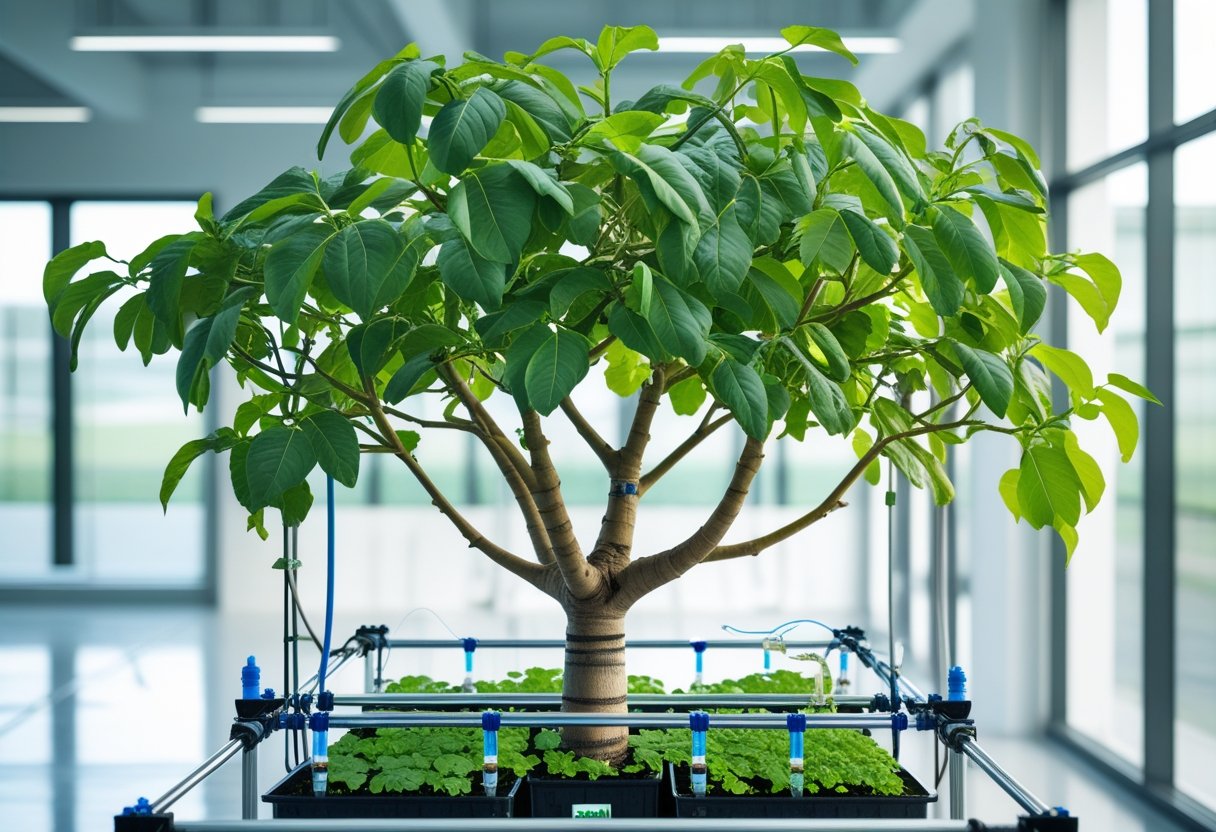
Hydroponic tree farming provides precise control over nutrients, water, and growing conditions. You can achieve higher yields and consistent growth patterns compared to conventional methods. However, success requires understanding which species work best and what equipment you need.
This guide will walk you through everything from selecting suitable tree varieties to setting up your system and maintaining healthy growth. You’ll discover the specific requirements for hydroponic trees, explore different system types, and learn about the latest innovations shaping sustainable agriculture.
What Is a Hydroponic Tree?
A hydroponic tree grows in nutrient-rich water solutions rather than soil, using precise mineral delivery systems to provide optimal growing conditions. This method offers faster growth rates but requires careful consideration of tree species and system capabilities.
Definition and Principles
A hydroponic tree is a tree grown in a mineral nutrient solution instead of soil, allowing for precise control over the tree’s nutritional supply. The system delivers water and dissolved nutrients directly to the plant roots through various growing mediums.
Core Components:
- Nutrient solution – Water mixed with essential minerals
- Growing medium – Perlite, rockwool, or coconut coir for root support
- Delivery system – Pumps and tubes for nutrient circulation
- Support structure – Framework to handle tree weight
Hydroponic systems operate as either active or passive mechanisms. Active systems use pumps to circulate nutrients, while passive systems rely on gravity or capillary action.
You can choose between recovery systems that recirculate nutrient solutions or non-recovery systems that drain away used solutions. Recovery systems reduce waste but require more monitoring for nutrient balance.
Comparison to Conventional Tree Growing
Growing trees hydroponically differs significantly from soil-based cultivation in resource usage and control methods. Hydroponic tree farming uses 98% less water than conventional approaches according to reforestation programs.
Key Differences:
| Aspect | Hydroponic Trees | Conventional Trees |
|---|---|---|
| Water usage | 98% less water | High water requirements |
| Growth speed | Faster maturation | Standard growth rates |
| Nutrient control | Precise delivery | Soil-dependent availability |
| Space efficiency | Compact systems | Large land requirements |
You maintain complete control over nutrient delivery in hydroponic cultivation. Traditional soil growing relies on soil composition and weather conditions for nutrient availability.
Hydroponic tree cultivation requires less fertilizer and pesticide than traditionally farmed trees. The controlled environment reduces pest issues and eliminates soil-borne diseases.
Key Advantages and Limitations
Advantages:
- Accelerated growth – Trees mature much quicker than soil-grown counterparts
- Space optimization – Ideal for urban gardening applications
- Water conservation – Significant reduction in water consumption
- Year-round production – Climate-controlled growing seasons
Hydroponic trees work best with smaller species and dwarf varieties created through grafting. You cannot successfully grow large species like oak trees or Great Basin bristlecone pines hydroponically.
Limitations:
- Size restrictions – Only smaller tree species remain viable options
- Infrastructure costs – Massive grow tanks needed for larger specimens
- Technical expertise – Less experience available compared to small plant hydroponics
- Weight considerations – Support systems must handle substantial tree mass
You need high ceilings and substantial space for indoor hydroponic tree systems. The initial investment for equipment and infrastructure can be considerable for full-sized tree cultivation.
Related Posts:
- Blueberries Hydroponics: A Guide to Master Year-Round Cultivation
- Closet Hydroponic Setup: Optimizing Space for Indoor Gardening
- Bear Paw Succulent Leaves Falling Off: Common Causes and Simple Solutions
- String of Watermelon Plant Care: Essential Tips for Healthy Growth
Suitable Tree Species for Hydroponic Systems
Specific tree species perform better in hydroponic environments than others, with dwarf fruit varieties like citrus, figs, and pomegranates leading the way. Your success depends heavily on selecting trees with compatible root systems and growth patterns for soilless cultivation.
Best Fruit Trees for Hydroponic Cultivation
Dwarf fruit trees like citrus, figs, and pomegranates thrive in hydroponic environments because they adapt well to controlled nutrient delivery systems. These varieties offer manageable sizes while maintaining productive fruit yields.
Top Performing Hydroponic Fruit Trees:
- Apple trees (dwarf rootstock varieties)
- Cherry trees (sour and sweet dwarf cultivars)
- Peach and nectarine trees (genetic dwarf varieties)
- Fig trees (compact Mediterranean varieties)
- Pomegranate trees (ornamental and fruiting types)
Fig trees excel in hydroponic systems due to their adaptable root structure and tolerance for controlled environments. They produce fruit faster than soil-grown counterparts when provided consistent nutrients.
Apple trees on dwarfing rootstock remain compact while producing full-sized fruit. You can expect fruit production within 2-3 years in optimal hydroponic conditions.
Popular Dwarf Varieties and Bonsai Options
Dwarf varieties offer the perfect solution for hydroponic tree cultivation because they maintain compact sizes while delivering full functionality. These trees typically reach 4-8 feet in height, making them ideal for indoor growing systems.
Recommended Dwarf Cultivars:
| Tree Type | Variety | Mature Height | Special Features |
|---|---|---|---|
| Apple | Honeycrisp Dwarf | 6-8 feet | Cold hardy, crisp fruit |
| Cherry | Stella Dwarf | 5-7 feet | Self-pollinating |
| Peach | Bonfire Patio | 4-6 feet | Genetic dwarf, ornamental |
Bonsai trees present unique opportunities for hydroponic cultivation. Japanese maples, junipers, and ficus varieties adapt well to nutrient film technique systems.
You can maintain bonsai trees indefinitely in hydroponic setups with proper pruning and root management. The controlled environment prevents many common soil-borne diseases that affect traditional bonsai.
Considerations for Tropical and Citrus Trees
Citrus trees rank among the most successful hydroponic tree species due to their shallow root systems and consistent growing patterns. Orange, lemon, lime, and grapefruit varieties all perform exceptionally well in controlled environments.
Essential Requirements for Citrus Success:
- Temperature: Maintain 65-75°F consistently
- pH Level: Keep between 5.5-6.5 for optimal nutrient uptake
- Light: Provide 12-14 hours of full spectrum lighting daily
Orange trees produce fruit year-round in hydroponic systems when environmental conditions remain stable. Meyer lemon trees offer particularly good results for beginners due to their forgiving nature.
Tropical species like avocado, mango, and papaya require higher humidity levels and specialized climate control. These trees need larger growing containers and more robust support systems than temperate varieties.
You must consider the two-phase root development process that affects many tree species in hydroponic cultivation. The initial lengthening phase followed by bark formation requires careful monitoring of nutrient concentrations and pH levels.
Types of Hydroponic Systems for Trees
Different types of hydroponic systems offer unique advantages for tree cultivation, with Dutch bucket systems and drip irrigation providing excellent root support for larger plants. Deep water culture and advanced techniques like nutrient film technique deliver precise nutrient control for optimal tree growth.
Dutch Bucket System
Dutch bucket systems excel for hydroponic tree cultivation because they provide individual containers for each tree’s root system. You place each tree in a separate bucket filled with growing medium like perlite or coconut coir.
The system delivers nutrient solution through drip lines to each bucket. Excess solution drains from the bottom and returns to the main reservoir through a collection pipe.
Key advantages for trees:
- Root space: Large containers accommodate extensive root systems
- Individual control: You can adjust nutrients for each tree separately
- Stability: Heavy bucket design supports mature trees effectively
This system works particularly well for fruit trees and larger specimens. The growing medium provides physical support while allowing roots to access oxygen freely.
You can easily scale Dutch bucket systems by adding more containers. The modular design lets you expand your hydroponic tree operation gradually.
Drip Irrigation Systems
Drip irrigation delivers nutrient solution directly to tree roots through a network of tubes and emitters. You control the flow rate and timing to match each tree’s specific water and nutrient requirements.
The system uses a pump to move solution from the reservoir through main supply lines. Individual drip emitters regulate the amount reaching each tree’s root zone.
System components:
- Reservoir tank for nutrient solution
- Pump and timer for automated delivery
- Distribution tubing network
- Drip emitters or micro-sprayers
- Drainage collection system
Drip systems offer excellent water efficiency for tree cultivation. You minimize waste by delivering solution precisely where roots can absorb it most effectively.
The automation capabilities reduce labor requirements significantly. Timers and sensors can maintain consistent feeding schedules without daily manual intervention.
Deep Water Culture
Deep water culture systems submerge tree roots directly in aerated nutrient solution. You suspend trees in net pots above reservoirs containing the growing solution.
Air pumps and stones provide continuous oxygenation to prevent root rot. The constant air bubbling ensures roots receive adequate oxygen despite being submerged.
Critical requirements for trees:
- Large reservoirs: Trees need substantial solution volumes
- Strong aeration: Bigger root systems require more oxygen
- pH stability: Larger solution volumes help buffer pH fluctuations
This system promotes rapid nutrient uptake since roots have constant access to dissolved minerals. You’ll observe faster initial growth compared to other hydroponic methods.
Deep water culture works best for smaller tree varieties or young specimens. Mature trees may become too heavy for typical DWC setups to support properly.
Nutrient Film Technique and Aeroponics
Nutrient film technique flows a thin layer of nutrient solution past exposed roots in sloped channels. The continuous flow provides nutrients while allowing air exposure for oxygenation.
NFT considerations for trees:
- Channel size must accommodate larger root systems
- Pumps need sufficient capacity for continuous flow
- Backup systems prevent root drying during power outages
Aeroponics suspends roots in air while misting them with nutrient solution at regular intervals. This method maximizes oxygen exposure while delivering precise nutrition.
Aeroponic advantages:
- Superior oxygenation promotes healthy root development
- Efficient nutrient delivery reduces waste
- Easy root inspection and maintenance access
Both systems require more technical expertise than bucket or drip methods. You need reliable equipment and monitoring systems to prevent root damage from interruptions.
These advanced techniques work better for smaller tree varieties or research applications. The complexity and equipment costs make them less practical for large-scale tree production.
Key Components and Requirements for Hydroponic Tree Growing
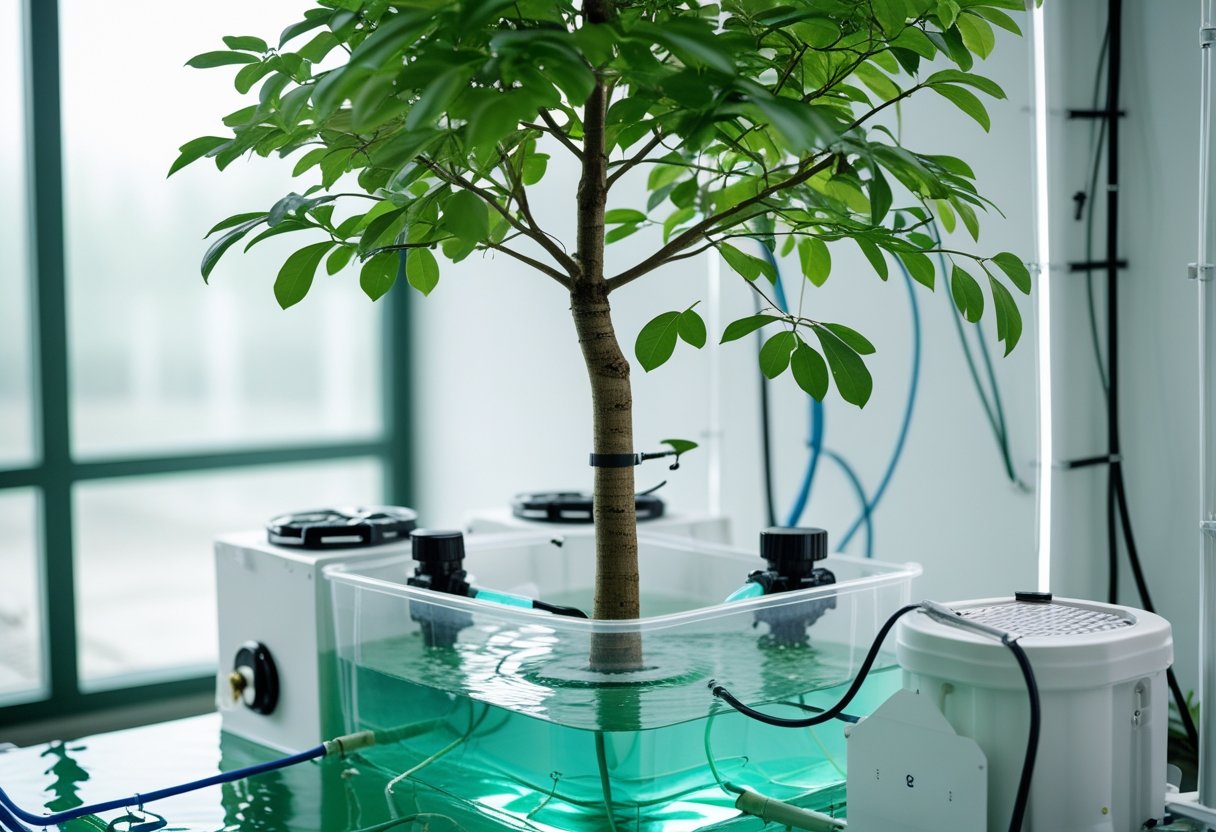
Growing trees hydroponically requires precise management of essential hydroponic system components including nutrient solutions, appropriate containers, specialized lighting systems, and controlled environmental conditions. These elements work together to replace the natural soil environment that trees typically depend on for growth.
Nutrient Solution Management
Your nutrient solution serves as the primary food source for hydroponic trees. Unlike smaller plants, trees consume significant quantities of nutrients due to their size and growth demands.
Essential Nutrients for Tree Growth:
- Macronutrients: Nitrogen (N), Phosphorus (P), Potassium (K)
- Secondary nutrients: Calcium, Magnesium, Sulfur
- Micronutrients: Iron, Manganese, Zinc, Boron
You must maintain nutrient concentrations between 800-1200 ppm for most tree species. Monitor pH levels between 5.5-6.5 to ensure optimal nutrient uptake.
The nutrient-rich water requires regular testing and adjustment. Replace your complete nutrient solution every 2-3 weeks to prevent salt buildup and nutrient imbalances.
Key Management Tasks:
- Test EC/TDS levels daily
- Check pH twice weekly
- Monitor individual nutrient ratios monthly
- Maintain water temperature between 65-72°F
Growing Mediums and Hydroponic Containers
Your choice of growing medium and container directly impacts root development and tree stability. Hydroponic containers must provide adequate support for tree-sized plants while allowing proper root aeration.
Recommended Growing Mediums:
| Medium | Benefits | Drawbacks |
|---|---|---|
| Clay pellets | Excellent drainage, reusable | Higher initial cost |
| Rockwool | Superior water retention | Single-use only |
| Coconut coir | Natural, sustainable | Requires pH buffering |
| Perlite | Lightweight, good aeration | Can float in solution |
Clay pellets work exceptionally well for trees because they provide structural support while maintaining proper air-to-water ratios around roots.
Your hydroponic containers need minimum volumes of 20-50 gallons depending on tree species and maturity. Deep water culture systems work best for established trees, while ebb-and-flow systems suit younger specimens.
Container depth should accommodate full root development, typically 18-24 inches minimum. Ensure adequate drainage holes and consider using net pots within larger reservoir systems.
Grow Lights and Artificial Lighting
Trees require significantly more light intensity than typical hydroponic vegetables. Your lighting system must provide sufficient photosynthetically active radiation (PAR) across the entire canopy.
Light Requirements by Tree Type:
- Fruit trees: 600-800 PPFD for 12-14 hours daily
- Ornamental trees: 400-600 PPFD for 10-12 hours daily
- Dwarf varieties: 300-500 PPFD for 8-10 hours daily
LED grow lights offer the best efficiency and heat management for large tree installations. You need full-spectrum lights with strong red and blue wavelengths plus supplemental far-red for proper stem elongation.
Position lights 18-36 inches from the canopy top. Use multiple light sources to ensure even coverage across all branches and leaves.
Calculate approximately 50-75 watts per square foot of growing space for adequate tree lighting. Consider adjustable hanging systems as your trees grow taller.
Climate Control and Environmental Factors
Maintaining stable environmental conditions becomes critical when growing trees hydroponically. Temperature control, humidity management, and air circulation require more precision than smaller plant systems.
Optimal Environmental Ranges:
- Air temperature: 68-78°F during day, 60-70°F at night
- Humidity: 50-60% for most species
- Air circulation: Gentle, constant movement
- CO2 levels: 400-800 ppm
You need robust ventilation systems to prevent fungal issues common in large plant installations. Install exhaust fans, intake vents, and oscillating fans to maintain air movement around all tree branches.
Monitor temperature fluctuations carefully, as trees are more sensitive to rapid changes than herbaceous plants. Use thermal mass or climate controllers to maintain stability.
Humidity control prevents both drought stress and fungal diseases. Dehumidifiers become essential in enclosed growing spaces with large transpiring trees.
Step-By-Step Guide to Starting a Hydroponic Tree
Starting your hydroponic tree requires careful system selection, proper plant establishment, and consistent monitoring. Success depends on choosing the right equipment, selecting appropriate tree varieties, and maintaining optimal growing conditions.
Planning and System Setup
Deep Water Culture (DWC) and Dutch bucket systems work best for hydroponic tree cultivation. These systems provide adequate root space and nutrient delivery for larger plants.
Choose a hydroponic growing system that accommodates your tree’s mature size. Dutch buckets excel for fruit trees, while DWC systems suit smaller ornamental varieties.
Essential Equipment:
- 5-gallon or larger containers
- Air pumps and stones
- pH meter and TDS meter
- Full-spectrum LED grow lights (if indoors)
- Water reservoir system
Install your air pump to deliver oxygen to the root zone. Trees require more oxygen than smaller plants due to their extensive root systems.
Set up your lighting system 18-24 inches above your tree. Fruit trees need 14-16 hours of light daily for optimal growth.
Test your water quality and adjust pH to 5.5-6.5. Most trees thrive in slightly acidic hydroponic solutions.
Selecting and Planting Your Tree
Choose dwarf or compact tree varieties for your hydroponic garden. Dwarf citrus trees, compact apple varieties, and ornamental trees adapt well to soilless growing.
Purchase trees with healthy root systems from reputable nurseries. Avoid root-bound plants that show signs of stress or disease.
Remove all soil from the roots using lukewarm water. Gently massage the roots to eliminate soil particles without damaging the root structure.
Planting Steps:
- Fill your container with expanded clay pebbles or rockwool
- Position the tree at the same depth as it grew in soil
- Secure the trunk with plant stakes if needed
- Add remaining growing medium around the roots
Mix your nutrient solution at 800-1200 PPM for established trees. Young trees require lower concentrations around 400-600 PPM.
Fill your reservoir and begin circulation immediately after planting. The transition period requires extra attention to prevent transplant shock.
Ongoing Care and Maintenance
Monitor your nutrient solution daily during the first month. Trees consume more water and nutrients as they establish in the hydroponic growing technique.
Change your nutrient solution completely every 7-10 days. Fresh solutions prevent nutrient imbalances and salt buildup that can harm tree health.
Weekly Maintenance Checklist:
- Check pH levels (maintain 5.5-6.5)
- Monitor PPM levels
- Inspect roots for health issues
- Clean air stones and pumps
- Prune dead or damaged branches
Adjust your feeding schedule based on growth stages. Flowering and fruiting trees need higher phosphorus and potassium levels.
Watch for common issues like nutrient deficiencies, root rot, or pest problems. Yellow leaves often indicate nitrogen deficiency or pH imbalances.
Prune your tree regularly to maintain size and promote healthy growth. Remove suckers and water sprouts that drain energy from fruit production.
Increase lighting duration during flowering periods to 16-18 hours daily. Adequate light ensures proper fruit development and prevents flower drop.
Hydroponic Tree Farming and Sustainable Agriculture
Hydroponic tree farming represents a significant advancement in sustainable agriculture practices, offering enhanced resource efficiency and reduced environmental impact compared to traditional soil-based methods. This innovative approach addresses modern agricultural challenges while providing viable solutions for both urban environments and commercial operations.
Benefits and Resource Efficiency
Hydroponic tree farming offers more efficient and economical growing methods with significantly less environmental impact than conventional techniques. You can achieve 90% water savings compared to traditional farming through precise nutrient delivery systems.
Your hydroponic tree farm eliminates soil-borne diseases and pests naturally. This reduction minimizes or eliminates pesticide use entirely.
Key efficiency advantages include:
- Faster growth rates due to optimized nutrient absorption
- Higher yield density per square foot
- Year-round production capabilities
- Precise control over growing conditions
Hydroponic systems promote sustainability by providing environmentally friendly crop cultivation. You maintain complete control over nutrient concentrations and pH levels.
Energy efficiency improves through controlled environment systems. Your trees receive exactly the nutrients they need when they need them.
Applications in Urban and Commercial Settings
Hydroponic trees play an exciting role in urban forestry and agriculture. You can establish productive tree farms in areas with poor soil quality or limited space.
Urban applications include rooftop gardens, vertical farming facilities, and indoor growing operations. Your hydroponic tree farm can operate in warehouses, greenhouses, or converted buildings.
Commercial applications encompass:
- Fruit tree production for local markets
- Ornamental tree cultivation for landscaping
- Research facilities for agricultural studies
- Educational demonstrations in schools and universities
You can scale operations from small residential setups to large commercial facilities. Sustainable crop production through hydroponics addresses food security challenges in urban areas.
Commercial hydroponic tree farming reduces transportation costs by enabling local production. Your operation can supply fresh produce directly to nearby communities.
Challenges and Considerations
Initial setup costs for hydroponic tree farming require substantial investment in equipment and infrastructure. You need specialized knowledge of nutrient management and system maintenance.
Primary challenges include:
- High upfront capital requirements
- Technical expertise demands
- Energy consumption for lighting and climate control
- System complexity compared to traditional methods
Technological advancements in monitoring systems and energy efficiency are making hydroponics more accessible. You must consider ongoing operational costs including electricity, nutrients, and equipment replacement.
Tree selection becomes critical since not all species adapt well to hydroponic systems. You need to choose varieties that thrive in soilless environments.
Maintenance requirements include regular system cleaning, nutrient solution changes, and equipment monitoring. Your success depends on consistent attention to these operational details.
Current Innovations and Future Outlook for Hydroponic Trees
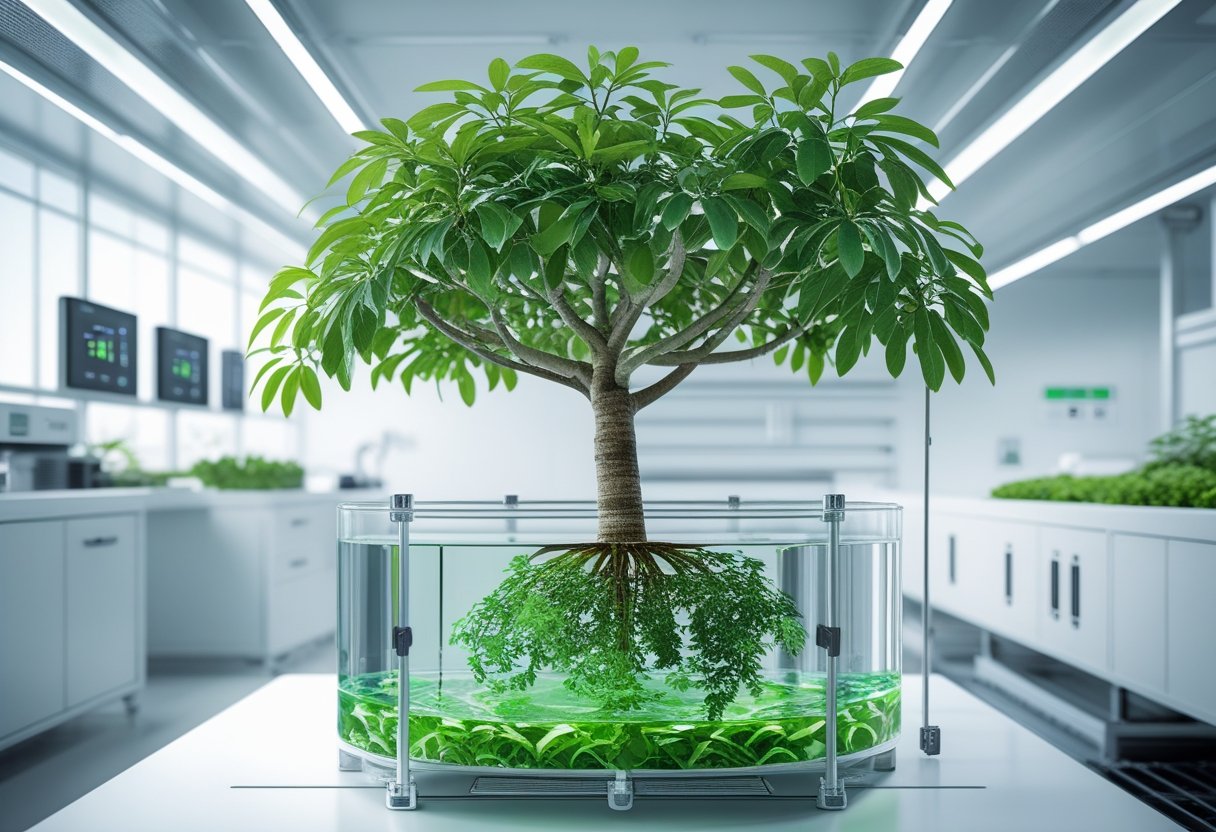
Advanced system designs now incorporate automated nutrient delivery and vertical growing structures, while AI-powered monitoring transforms how you manage tree cultivation. These developments position hydroponic trees to significantly expand food production capacity in urban environments and controlled agricultural settings.
Recent Advancements in System Design
Modern hydroponic tree systems feature multi-tier vertical configurations that maximize growing space efficiency. These designs allow you to cultivate multiple tree levels within the same footprint, increasing yield per square foot by 300-400% compared to traditional methods.
Automated nutrient delivery systems now provide precise control over fertilizer distribution. You can program these systems to adjust nutrient concentrations based on tree growth stages and specific variety requirements.
Deep Water Culture (DWC) adaptations for trees include reinforced root support structures and enhanced oxygenation systems. These modifications accommodate the larger root systems that fruit trees develop over time.
Modular growing containers enable you to expand operations incrementally. Each module contains integrated lighting, climate control, and nutrient circulation designed specifically for tree cultivation requirements.
Climate-controlled growing chambers maintain optimal temperature and humidity ranges year-round. These enclosed systems protect your trees from external weather variations while providing consistent growing conditions.
Related Posts:
- How to Start a Small Hydroponic Garden: The Ultimate Beginner’s Guide
- Most Common Mistakes of First-Time Gardeners: Avoid These Top Beginner Blunders
- Verti-Gro Hydroponic System: Revolutionizing Modern Agriculture
- When to Pick Ghost Peppers: Optimal Harvest Timing Guide
Emerging Technologies and Practices
AI and machine learning technologies now monitor tree health through computer vision systems that detect early signs of disease or nutrient deficiencies. These systems analyze leaf color, growth patterns, and fruit development to optimize care protocols.
Smart sensor networks continuously track pH levels, electrical conductivity, and dissolved oxygen concentrations. You receive real-time alerts when conditions deviate from optimal ranges for your specific tree varieties.
Precision nutrient formulations tailored for different tree species eliminate guesswork in fertilization. These customized solutions account for the unique mineral requirements of citrus, stone fruits, and tropical varieties.
LED lighting systems with full spectrum capabilities replicate natural sunlight patterns. Advanced controllers adjust light intensity and wavelength throughout daily cycles to maximize photosynthesis efficiency.
Automated pruning robots perform precise branch trimming based on programmed growth patterns. These systems maintain optimal tree shape while reducing labor requirements for large-scale operations.
Potential Impact on Food Production
Urban food security improvements become possible as cities adopt hydroponic tree systems in vertical farms and rooftop installations. You can produce fresh fruit within metropolitan areas, reducing transportation costs and carbon emissions.
Year-round production cycles eliminate seasonal limitations that affect traditional orchards. This consistency allows you to harvest fruit continuously rather than during specific months.
Water usage reduction of up to 90% compared to soil-based cultivation makes hydroponic trees viable in drought-prone regions. Closed-loop systems recycle nutrient solutions while minimizing waste.
Pesticide-free fruit production becomes standard practice in controlled hydroponic environments. You eliminate exposure to soil-borne pests and diseases that typically require chemical treatments.
Higher yields per acre result from optimized growing conditions and space-efficient vertical designs. Commercial operators report 5-10 times greater fruit production compared to traditional orchard methods in equivalent growing areas.
Frequently Asked Questions
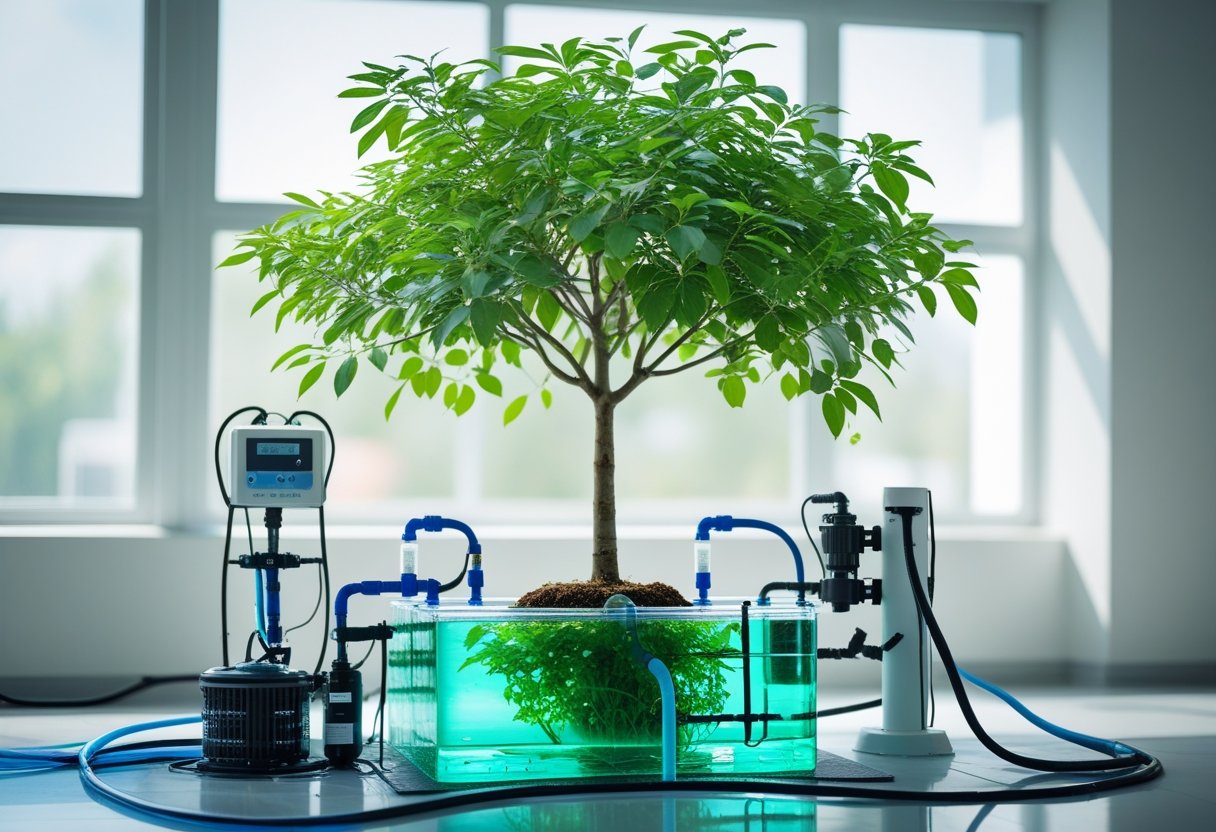
Growing trees hydroponically requires specific equipment, proper setup techniques, and careful tree selection. Success depends on understanding system components, choosing appropriate tree varieties, and implementing correct cultivation methods.
What are the necessary components for a DIY hydroponic tree system?
You need a large reservoir tank capable of holding 50-100 gallons of nutrient solution for mature trees. The container must be food-grade plastic or fiberglass to prevent chemical leaching.
A powerful water pump rated for continuous operation is essential. You’ll also need air pumps with air stones to maintain dissolved oxygen levels above 5 ppm in the root zone.
Growing medium options include expanded clay pebbles, perlite, or coconut coir. These materials provide root support while allowing proper drainage and aeration.
pH and EC meters are crucial for monitoring nutrient solution quality. You’ll need pH adjustment solutions and concentrated hydroponic nutrients formulated for woody plants.
Support structures like trellises or stakes become necessary as trees grow. Timers control lighting cycles and pump operations automatically.
How do I properly set up a hydroponic system for growing trees?
Start by placing your reservoir in a cool, dark location to prevent algae growth. Fill it with filtered water and adjust pH to 6.0-6.5 for optimal nutrient uptake.
Install your growing containers at least 12-18 inches apart to accommodate root systems. Connect water lines from the pump to each growing site with proper drainage back to the reservoir.
Add nutrients according to manufacturer instructions, typically starting at 800-1200 ppm EC for young trees. Monitor and adjust levels weekly as trees consume nutrients.
Position grow lights 18-24 inches above seedlings, adjusting height as trees grow. Provide 14-16 hours of light daily for most tree species.
Test your system for leaks and proper water circulation before introducing plants. Ensure all connections are secure and pumps function correctly.
Which types of trees are best suited for hydroponic cultivation?
Dwarf fruit tree varieties work exceptionally well in hydroponic systems due to their compact size and manageable root systems. Apple, pear, and cherry trees on dwarfing rootstock remain under 8 feet tall.
Citrus trees including lemons, limes, and oranges adapt well to hydroponic growing. Meyer lemons and key limes are particularly suited for indoor cultivation.
Fast-growing deciduous trees like willow and poplar respond well to controlled nutrient delivery. These species show rapid growth rates in hydroponic setups.
Ornamental trees such as Japanese maple and flowering dogwood can be successfully grown hydroponically. Their smaller mature size makes them ideal for container systems.
Avoid large forest trees like oak or pine, as their extensive root systems and size requirements exceed most hydroponic system capabilities.
Can fruit trees be grown using hydroponic methods, and if so, which ones?
Yes, many fruit trees thrive in hydroponic systems when proper techniques are applied. Dwarf varieties produce full-sized fruit while maintaining manageable plant size.
Apple trees on M9 or M26 rootstock work well hydroponically. Popular varieties include Honeycrisp, Gala, and Fuji, which fruit within 2-3 years.
Stone fruits like peaches, plums, and apricots succeed when grafted onto dwarfing rootstock. Choose self-pollinating varieties to ensure fruit production.
Berry trees including blueberry and elderberry adapt excellently to hydroponic growing. Blueberries require acidic conditions with pH maintained at 4.5-5.5.
Fig trees are particularly well-suited for hydroponic cultivation. Varieties like Chicago Hardy and Petite Negra remain compact while producing abundant fruit.
What are the advantages of using a hydroponic tower for growing trees?
Vertical towers maximize growing space in limited areas by stacking multiple planting levels. You can grow 3-4 dwarf trees in the same footprint as one traditional container.
Water and nutrient distribution becomes more efficient through gravity-fed systems. The tower design ensures even nutrient delivery to all plants simultaneously.
Root oxygenation improves significantly in tower systems due to enhanced drainage and air circulation. This prevents root rot and promotes healthier root development.
Maintenance and harvesting become easier at eye level compared to ground-level containers. You can inspect plants and collect fruit without bending or kneeling.
Space efficiency makes towers ideal for urban growing or greenhouse operations. The vertical design allows for higher plant density per square foot.
How does hydroponic cultivation compare to traditional soil gardening in terms of yield and growth rate?
Hydroponic trees typically grow 25-50% faster than soil-grown counterparts due to optimized nutrient delivery. Root systems develop more efficiently when nutrients are readily available.
Fruit production often increases by 20-30% in hydroponic systems. Consistent nutrient supply and water availability eliminate stress factors that reduce yields.
Growing seasons extend significantly with controlled environment hydroponic setups. You can maintain optimal growing conditions year-round regardless of weather.
Disease and pest issues decrease substantially without soil-borne pathogens. This reduces the need for pesticides and fungicides compared to traditional growing.
Water usage decreases by 70-90% through recirculating hydroponic systems. Nutrients are also used more efficiently with less waste through runoff or leaching.
Initial setup costs are higher for hydroponic systems, but operational efficiency often compensates within 2-3 growing seasons.